
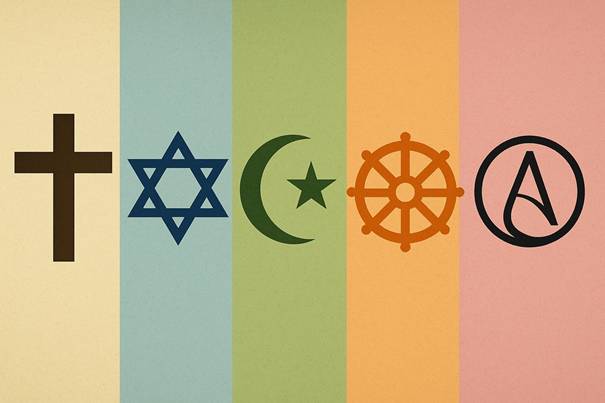
The previous block articles first dealt with questions that a worldview should answer, then with certain facts that a worldview should explain and finally with a method of comparing competing worldviews in terms of their truthfulness. This article is intended to give an overview of frequently held worldviews.
There are many different worldviews. This includes a wide variety of religions/belief systems as well as non-religious worldviews, which ultimately also represent belief systems. In principle, the worldview differs from person to person in detail. But many people can roughly assign the worldviews mentioned here. I have banished some interesting additional information to the footnotes so that the article does not become too long.
With regard to religions, many say that they are basically all the same or at least very similar. Now is that true or just a statement to avoid an unpleasant conversation? It may be that on the surface many belief systems and/or religions are similar, but on closer inspection it turns out that they are fundamentally different and even mutually exclusive in central points.
Comparison of different worldviews / world religions
In the following, we will now take a look at some worldviews. There is no claim to completeness here. Table 1 makes a comparison of atheism and the world religions Buddhism, Hinduism, Christianity, Islam and Judaism regarding God, the hereafter and ethics.[1]
I have summarized the explicitly monotheistic religions, Christianity, Islam and Judaism here for the time being. A further division will take place later.
| Atheism | Buddhism | Hinduism | Christianity/ Islam/Judaism | |
| God | No God | Not a god in the classical sense. Details depend on the type of Buddhism.[2] | Depends on the form: [3] A god, Thousands of gods, forms in between, All reality is one and this is God (pantheism) | A God (Monotheism) |
| The Hereafter & Co. | No afterlife | Various teachings about God, reality, sin, heaven and hell | ||
| Ethics | Ethical views vary greatly. | Partly similar ethical teachings (e.g. helping the poor) but also differences (e.g. love of enemies in Christianity) | ||
Table 1: Comparison of different worldviews.
Furthermore, Table 2 shows a comparison regarding God’s existence and its relationship to creation. Here, in addition to monotheism[4], I have and atheism: deism, polytheism and pantheism. [5]
| God | Relationship between God and creation | Examples | |
| Monotheism | God exists | God created everything and works in creation. God and creation are separate. [6] | Christianity, Judaism, Islam, forms of Hinduism, people without a specific religion who believe in a God[7] |
| Deism | God exists | God created the universe in the beginning and then no longer worked in the world. God and creation are separate. | This view arose mainly during the Enlightenment and cannot be assigned to any religion. |
| Polytheism | Many Gods | Gods are usually parts of creation. | Greek and Roman Gods Pantheon |
| Pantheism[8] | An impersonal deity present in matter and energy is the basic reality.[9] | God and nature are identical. | New Age, Forms of Hinduism, Zen Buddhism |
| Atheism | no god | There is only the universe and no creation, since the word creation implies a creator. | According to a Gallup poll from 2022, about 10% of all people worldwide are atheists.[10] |
Table 2: A subdivision specifically to the question of God’s existence and his relationship to creation.
Comparison of the main monotheistic religions in relation to Jesus
If a personal God is the basis of all existence and the creator of the world, then atheism, Buddhism, many forms of Hinduism are excluded and Judaism, Islam, Christianity and monotheistic forms of Hinduism remain from the religions considered above.
Judaism, Islam, and Christianity are fundamentally different with regard to Jesus and what God is like in Himself. And the monotheistic form of Hinduism does not know Jesus at all.[11] Table 3 provides an overview.
| Judaism | Christianity [12] | Islam[13] | |
| Nature of God | A God[14] | A triune God. God is tri-personal: one being, three persons – Father, Son and Holy Spirit | A God (explicitly Unipersonal) Rejects Trinity |
| Jesus | Jesus was Jewish, but was rejected by most Jews around him. Jesus’ first disciples were all Jews. Today’s Judaism rejects Jesus as the Messiah or Son of God![15] | true man and true God; Son of God | Jesus is only a prophet.Islam denies that Jesus is God’s Son/God. Death on the cross and resurrection are rejected. |
Table 3: Jesus in Judaism, Islam and Christianity.
There are also many people who believe that there is a God but do not belong to any religion. For them, Jesus was usually a good teacher.
If Christianity is right about Jesus, cannot be true at the same time and are therefore wrong. And since the monotheistic forms of Hinduism do not include Jesus, they would also be excluded.
To find out which worldview is true, it is not enough to show that others are wrong. No, you also should have reasons for your own position if you think it’s the right one.
Most people don’t even know how much evidence there is that Christianity is true. We’ll take a closer look at this in later articles. For example, we will look at the reliability of the New Testament and the historical evidence of the life, death and resurrection of Jesus Christ and his statements.
I will also explore the question of God’s existence in further articles.
Conclusion
The widespread view that all world religions teach the same thing in principle is of course wrong. They are simply too different and sometimes contradict each other in fundamental aspects. However, this should not prevent us from treating people of other worldviews with respect and from representing our worldview with good arguments and in love.
[1] Then there is agnosticism (not listed in the table), which is further divided into soft and hard agnosticism. “Soft agnosticism” (also called weak or mild agnosticism) is a position that leaves open the possibility that the existence or non-existence of a god or supernatural power could be proven scientifically or by other means in the future. In contrast to “hard agnosticism”, which claims the impossibility of any knowledge about it, agnostics do not rule out the possibility that new insights could emerge in the future that could answer the question of existence.
[2] In Buddhism there are supernatural beings, but no god in the sense of a supreme being, who is the creator of everything. (see e.g.: https://en.wikipedia.org/wiki/Creator_in_Buddhism or https://bschawaii.org/shindharmanet/atheism/)
[3] Hinduismus ist ein breiter Begriff welcher die indigenen Religionen Indiens, ohne spezifischen Gründer, ohne eine einzige vereinende Geschichte und ohne eine vorgeschriebene, vereinheitliche Anbetungspraxis umfasst. Daher kann man sagen, dass es nicht DEN Hinduismus gibt. Z.B. Gerald McDermott schreibt in seinem Buch über Weltreligionen: “Instead of one religion called Hinduism, there are many religions in India, often contradictory and wildly conflicting in beliefs. That’s the reason I have titled this chapter “Hinduisms: The World’s Oldest Set of Religions.” A more accurate title would be “the native religions of India.” I say “native” because Christianity, Islam, and Buddhism (as well as others) are also flourishing religions in India, with millions of adherents there, but they were founded elsewhere.” Farhadian, C. E. (2015). Introducing world religions: a Christian engagement / Charles E. Farhadian. Baker Academic, a division of Baker Publishing Group. Page 63.
[4] For monotheism, there are the following intermediate forms, among others:
- Monotheism with subordinate gods: there is a God who is the basis of all existence and the creator of everything, but who has created several second-class deities.
- Henotheism (see e.g. https://de.wikipedia.org/wiki/Henotheismus)
- Monolatry (see e.g. https://de.wikipedia.org/wiki/Monolatrie)
- Panentheism: God is greater than the universe, encloses it and permeates it.
[5] There are also more exotic points of view, such as the universe being a simulation. But then the problem is postponed one step further. Ultimately, the question arises, what is the basic reality?
[6] A special form is so-called idealism, according to which reality is mental. In relation to God, this means that the phenomenological world as we experience it is an idea in the mind of God. See, for example, Farris, Robert and Robert J. Marks II, “Mind Over Matter: Idealism Ascendant.” in Minding the Brain: Models of the Mind, Information, and Empirical Science, ed. Robert J. Marks II et al. (Seattle: Discovery Institute Press, 2023).
[7] There are other monotheistic traditions, such as the atonism of ancient Egypt (see e.g. https://de.wikipedia.org/wiki/Monotheismus)
[8] There are different forms of pantheism (e.g. https://www.biblicalcyclopedia.com/P/pantheism.html)
[9] Stephen C. Meyer, Return of the God Hypothesis: Three Scientific Discoveries That Reveal the Mind Behind the Universe (New York: HarperOne, 2021), 340, Kindle edition.
[10] https://de.wikipedia.org/wiki/Liste_der_L%C3%A4nder_nach_Religiosit%C3%A4t
[11] Hinduism considers Jesus only from the 19th century on.
[12] In addition, there are various sects that have sprung from Christianity and reject basic teachings such as the Trinity (such as Jehovah’s Witnesses). These will not be considered further here, because if it turns out that classical Christianity is right, they are automatically wrong because they have a completely different understanding of Jesus
[13] In the case of Islam, too, beyond the main branches of Sunni Islam and Shia Islam, there are different sects which have split from classical Islam. These are also not considered further because their view of Jesus would not differ much from classical Islam.
[14] There was also a view in Judaism in which God exists through at least two persons and which derives from certain passages in the Old Testament (see, e.g., Alan F. Segal, Two Powers in Heaven: Early Rabbinic Reports about Christianity and Gnosticism (Leiden: E. J. Brill, 1977; repr., Waco, TX: Baylor University Press, 2012).
[15] There are still Messianic Jews. These are Jewish Christians who have also retained certain rules from the Torah.
Leave a Reply